Along the Maasdijk between Ravenstein and Lith, there's no roaring diesel engine. Only the soft sound of the hydraulic system and the breaking of wet clay. On the Meandering Maas project, Boskalis Nederland will be working with electric excavators along a stretch of over 26 kilometers until 2030, pioneering a new chapter in sustainable earthmoving.
Boskalis Nederland always strives for the best solutions, developing innovative ideas, particularly in the area of sustainability. Whether it involves land reclamation, dike reinforcement, construction of roads, bridges, and viaducts, or major earthmoving, as a leading contractor, Boskalis combines its years of experience with the latest technologies to make a positive sustainable impact. "We have set ourselves the goal of making our activities climate-neutral in the Netherlands by 2030," says Anton van Dongen, Head of Technical Services (Dry Equipment) at Boskalis. "That's a huge ambition, and it aligns with how we view the future. Sustainability goes beyond just electrical equipment. It touches everything: from design and logistics to maintenance and energy management."
The post continues below the video. Also check out the photo album at the bottom of this post.
Video: View the machine in the field
In the search for suitable electrical equipment, service life played a crucial role. "A machine that needs to recharge after eight hours of operation is simply not feasible. We don't want machines that are idle; we want to be able to operate for a full workday," says Van Dongen. "The concept of interchangeable Powerbox 400 battery packs was the main reason for us to work with Staad. Moreover, the machines were available quickly."
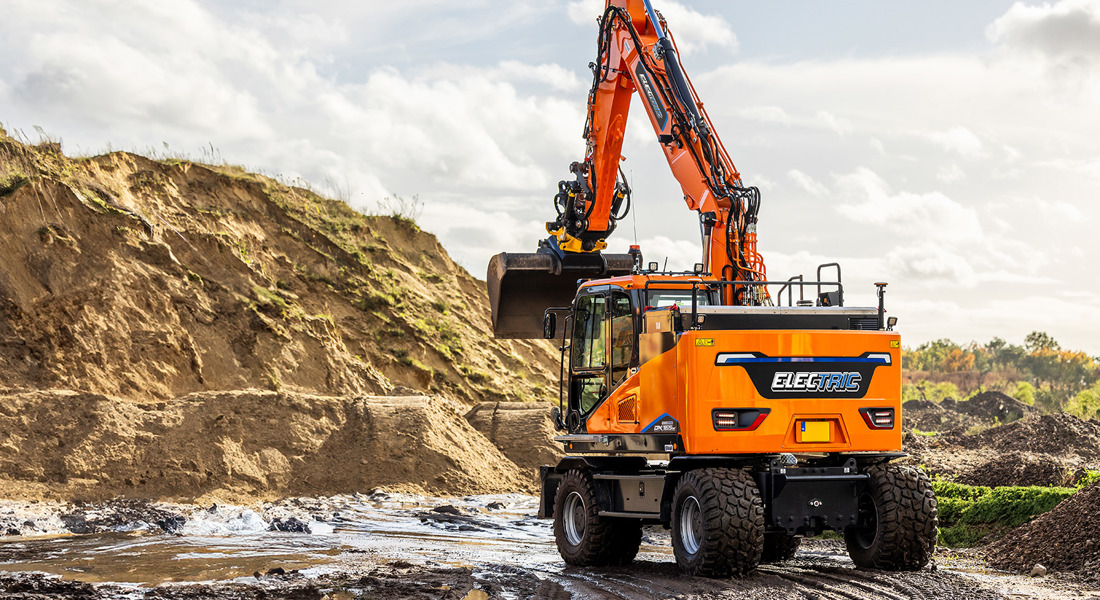
Boskalis currently has three DX355LC Electric crawler excavators, two DX165W Electric wheeled excavators, and a DL285 Electric wheel loader in operation, and has also ordered two more DX355LC Electric excavators. Sixteen Powerboxes with a capacity of 400 kWh have also been delivered to keep the machines running smoothly. "These interchangeable Powerboxes are invaluable. A depleted Powerbox can be replaced within five to ten minutes, allowing work to continue. That's faster than refueling. Thanks to a special frame with a central lifting eye, it's also considerably safer, as the operator doesn't have to climb onto the superstructure to secure a four-way junction."
Switching to Staad as a new manufacturer initially required considerable coordination, which is understandable. "We sparred a lot with each other in the beginning," says Van Dongen. "Boskalis is used to custom work, so we wanted the DX355LC Electric crawler excavator with a wider and raised undercarriage, longer booms, and additional counterweight." The collaboration went remarkably smoothly, thanks in part to the assembly manual. "That was new to us. It makes the choices you make together clear from day one. That made the final delivery a piece of cake."
The instructional booklet immediately clarifies the choices you make together. This made the episode a breeze.
That electric equipment has now firmly established itself at Boskalis is partly thanks to the people on the shop floor. Although that didn't happen automatically, the Head of Technical Services frankly admits. "When we put out a call for operators to work with the electric crawler excavator, it was remarkably quiet. There was a real feeling it would stop halfway through the day with dead batteries. But now? Everyone's enthusiastic. The quiet cabin and smooth operation make it a truly fantastic excavator."
Post continues below the image

The electric earthmoving machines are now fully operational on emission-free projects like "Meandering Maas," where Boskalis is reinforcing the Maasdijk dike and simultaneously creating more space for the river. The 35-ton electric excavators are ideal for profiling and heavy earthmoving. "We simply attach a serious bucket to them, although we're still looking for the right bucket size to balance productivity with power consumption. The capacity is excellent, and since the latest software update, they also lift faster. We like to get the most out of every machine."
Working electrically also requires a smart energy supply. According to Van Dongen, that's where the biggest learning curve lies. "The technology is good; that's not the problem. The challenge lies in the charging infrastructure. You can't charge an excavator with a 400 or even 800 kWh battery capacity at a simple 11 kW car charging station. So we have to take the initiative ourselves." For example, a complete charging plaza has been set up at Meandering Maas, and in other locations, partners with a heavy-duty grid connection are being sought. Sometimes, the company's own biogas generator helps out. "Where possible, we seek collaboration with local partners. That works perfectly for the mobile excavators, which can drive to a charging station themselves."
Post continues below the image

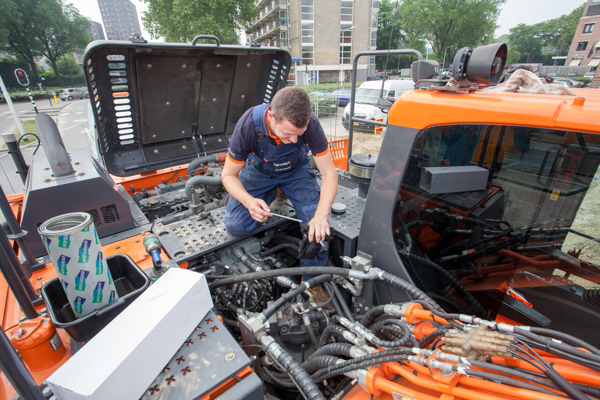
The transition to electric operation also changes the maintenance regime. Fewer moving parts means less wear and tear. "Our mechanics are on the job less often," says Van Dongen. "It's similar in terms of hydraulics, but otherwise it's a completely different story. We're currently monitoring maintenance costs, but the overall picture looks positive." Moreover, technical support is now largely digital. "Remote monitoring is provided, and updates are implemented regularly. That significantly reduces the burden on our own technical department."
The machine with interchangeable Powerbox 400 battery packs was the main reason for us to choose Staad.
The first phase of electrification has primarily taught us the importance of thorough preparation. "You can have the most impressive machines, but if the charging infrastructure fails, everything grinds to a halt. That's truly a task for the entire sector." Van Dongen is optimistic about the future. "One of our hopes is that different charging systems will be able to communicate with each other independently of the manufacturer. That would truly make a difference in the market for electric equipment. In five years, our construction sites will have an even wider range of electric machines. Staad already has a 23-ton version in the pipeline, and we hope to have something between 35 and 55 tons as well."
This article was published in Grondwerk magazine, Winter 2025 edition. Would you also like to receive this beautiful magazine? Click here.
View the full photo album below.


Contact us. We are happy to tell you more about it!