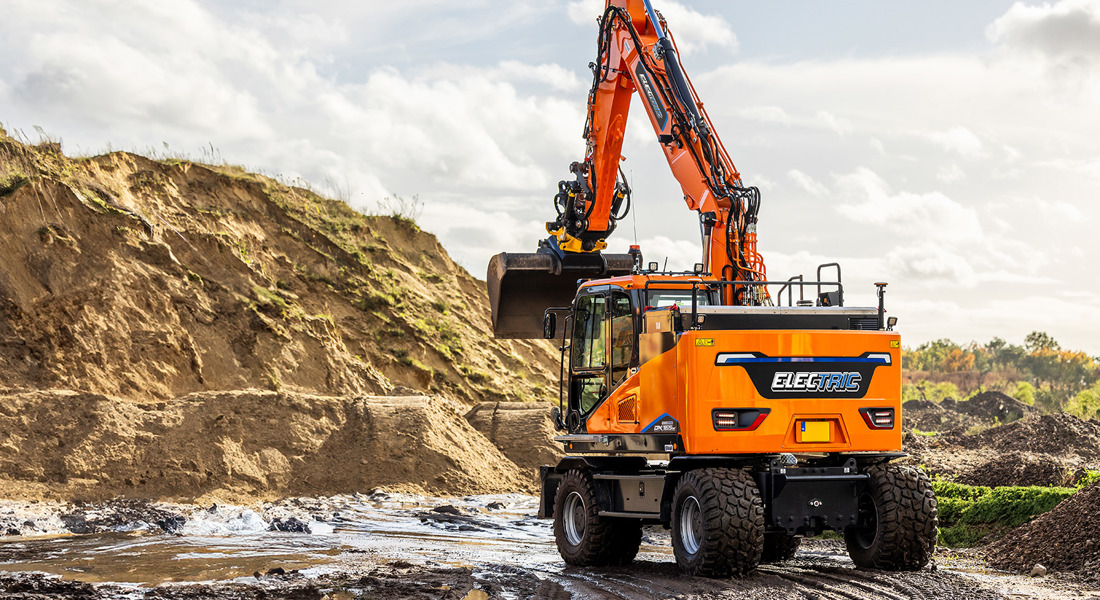
If there's one company at the forefront of sustainable operations and electrification, it's Boomrooierij Weijtmans . Just ask director Kees Weijtmans. Along with several other companies, Weijtmans participated in the DKTI (Demonstration Scheme for Climate Technologies and Innovations) project "Construction Site of Tomorrow" between 2021 and 2024. As part of this project, the use of electric machinery was monitored for three years. This provided valuable insights into deployability, energy consumption, emission savings, and logistical challenges. "It was worth it," says Kees. "As a pioneer, you have valuable learning opportunities, gain initial experience, and bridge the gap between the drawing board and practice." Weijtmans' machinery fleet is now largely electrified. Last June, a second DX165W Electric mobile excavator was delivered.
“All wood is no timber.”
This old Dutch proverb is literally true when we visit Boomrooierij Weijtmans in Udenhout. The yard is filled with impressive piles of felled trees. All for various uses: from pallet wood, construction timber, and furniture to wood chips and firewood.
The post continues below the video. Also check out the photo album at the bottom of this post.
Video: Harvesting in the Brabant forests
Kees is a sixth-generation tree harvester. Jacobus Weijtmans laid the foundation for the company between 1779 and 1847. After deserting from the army of the French occupying forces, he began harvesting trees in the Brabant forests with a borrowed army horse. His son Kiske (nicknamed Kiske the Tree Harvester) followed in his footsteps. His son, Jan, and grandson Kees laid the foundation for the current company in 1921. The current owner's father took over the business in 1962.
When Kees succeeded his father in 2000, Weijtmans employed seven people and had a turnover of 1.5 million guilders. "Today, we have 45 employees and a more than healthy turnover," he says. "We are the largest tree feller in the Netherlands, and we are proud of that. We have always distinguished ourselves with craftsmanship and innovative solutions." The telescopic crane developed by Weijtmans is a good example of this. This machine can grip and saw off branches in a controlled manner up to 42 meters high.
Post continues below the image

Weijtmans distinguishes itself from other players in the market in several ways. Sustainability is a key theme. In 2019, the company moved into a new building on Handelsweg in Udenhout, sustainably built and energy-neutral in operation. Over 700 solar panels generate electricity, the building is heated and cooled via an air circulation system, and the roof is covered with succulents that insulate it, retain water, and attract insects. Light-colored paving contributes to global warming prevention. "Electrifying our machinery was a logical next step to differentiate ourselves in the market," says Kees. So, a telehandler, a self-propelled aerial work platform, two buses, and two trucks were added, all electric, complete with battery packs. The first mobile electric excavator was delivered in the spring of 2022 and was the very first DX165W Electric mobile excavator in the Netherlands. Kees explains: "We jumped on board enthusiastically. Our operator saw the electric machine as a challenge. And we had Tim, Staad's mechanic. We could always call him, and he was immediately available if we had any problems. There's a clear focus on preventing machine downtime. That reliability ultimately gave us the confidence to purchase a second machine."
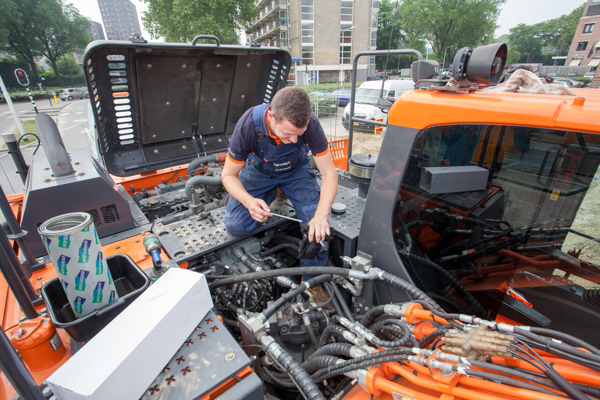
This summer, it was time for the new, emission-free DX165W Electric mobile excavator. "Everything we learned from the experiences with the first machine has now been incorporated into this second machine," says Kees. "The operator's experiences are very positive. The machine produces less noise and no exhaust fumes without sacrificing power. This electric mobile excavator runs on the Powerbox 400, which makes it easy to work a full workday without recharging. And that power and endurance are essential in the field where this machine is put to work, especially with the Hunter Fellflex multigrip with integrated Hultdins saw head as equipment." In the Staad workshop, the machine was fitted with additional options at Weijtmans' request, including driveline protection for forestry work, extra protection on the rear lights, a solid plastic one-piece front window, hydraulic quick coupler, automatic grease lubrication, overpressure preparation, a lifting eye on the dipperstick, and Nokian Excavator tires.
Post continues below the image

Kees believes Weijtmans should lead by example. “We’re a family business and we want to safeguard that for future generations. Anyone who wants to be a leader has to be willing to take risks. That doesn’t mean you shouldn’t only make responsible investments. We’ve invested millions, knowing that returns are a long-term commitment. While we may be distinctive in the market, the additional costs haven’t been recouped yet.” Nevertheless, he firmly believes in electrification. “If Tesla hadn’t introduced an electric car, the major brands would never have followed suit. I’m convinced that electrification is the right path, and we’re seeing that zero-emission operations are increasingly becoming a factor our clients consider. With the right partners and strong entrepreneurship, I have great confidence in the future.”
This article was published in Grondwerk magazine, Winter 2025 edition. Would you also like to receive this beautiful magazine? Click here.
View the full photo album below.


Contact us. We are happy to tell you more about it!