Working entirely electrically; that is the vision of Beentjes Grond-, Weg- en Waterbouw from Uitgeest, North Holland. Beentjes GWW has been successfully promoting this vision for some time now. We spoke about it with Frans Beentjes, director of the Beentjes Bouwgroep and the namesake grandson of the company's founder.
Frans Beentjes Sr. started the paving company Beentjes in Heemskerk in 1960 together with his brothers. Frans' son Henk took over the reins, and in 2013, his son Frans joined the company. Over the years, Beentjes GWW grew into a general contractor in civil engineering. “Our specializations are spatial planning, water management, and bridges. Think of sewerage work, road reconstructions, pumping stations, and all types of bridges,” explains Frans. Beentjes GWW currently has around 55 employees and an extensive fleet of vehicles and machinery, nearly 80% of which consists of electric equipment. The clients mainly come from North and South Holland and Flevoland.
The post continues below the image. Also view the photo album at the bottom of this post.

“We cannot improve the world, but as a company, we can contribute to a better world. And we sincerely want to do that. That is why we have been on the path to zero-emission operations since 2018,” says Frans. He is fascinated by the technology that makes zero-emission work possible. “We jumped on board with that. In the beginning, we were told that electric machines would never be able to replace diesel machines. But that is a mindset. By working differently and by adapting certain things, we can do exactly the same thing as we do with diesel machines. And Staad has become an important partner in this because they are at the forefront of electric machines and battery technology.”
Frans dismisses the notion that electric machines are less powerful than diesel machines. “The heart of every machine is the hydraulic pump. How it is driven – electrically or by diesel – makes no difference. The difference lies in how you obtain that energy. We are used to a combustion engine. When the tank is empty, you go to the pump. You are fully refueled in five minutes. With electric machines, you have to think about charging points. That is why, in the preliminary phase, we look at charging points in the work area together with the client.” For instance, the municipality of Zaanstad has already arranged charging points for a large residential area where Beentjes GWW will be replacing the sewer system and paving electrically.
Message continues below the image

Beentjes GWW has arranged its battery supply well. “We have invested in extra Powerboxes that we can swap ourselves. That makes us more flexible in our work and in where we can charge.” Frans explains, as a field expert, that they can operate for well over twelve hours with Staad’s machines. “So we can work all day and charge at night. We have hub locations in Zaandam and Amsterdam where we can charge our electric machines. And because we do a lot of inner-city work, we use car charging stations to charge our batteries at night. That works us easily, also because the electric machines aren't completely empty by the end of the day.”
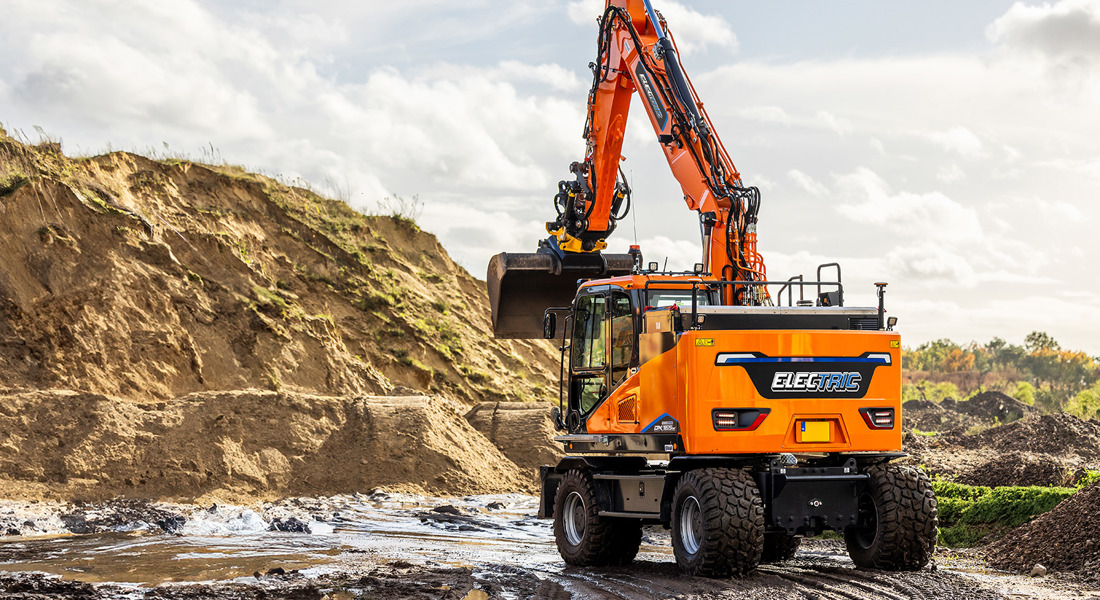
Beentjes GWW has three DX165W Electric mobile excavators and is in talks regarding a STAAD 23LC electric crawler excavator . According to Frans, the STAAD 23LC is the last machine missing to be able to offer all work completely emission-free. “With the DX165W Electric excavators, we can offer a lot of work, but for deeper sewer work and working in soft ground, a crawler excavator is indispensable. It has a larger contact area and works better on unpaved terrain. Unlike in other parts of the country, where you dig a hole, reinforce the sewer trench, and then lay your sewer, here in the west everything has to be founded. We have mastered that technique by now.”
Message continues below the image

Frans is enthusiastic about the development of the new STAAD 23LC, which he believes has exactly the right, compact size for inner-city areas. “Thanks to the shorter turning radius, the crawler excavator fits better between buildings.” However, some logistical considerations remain. For instance, transporting a crawler to a charging point is a bit more involved. Therefore, consideration is now being given to transporting the Powerboxes to a charging point using an electric truck and exchanging the fully charged Powerboxes themselves.
With Staad's machines, we can run for well over twelve hours.
For Frans, it is crystal clear that Beentjes GWW serves as a role model in the region when it comes to emission-free working. “As a company, we demonstrate that we are a frontrunner in electric working. We show this to our customers. Even where emission-free working is not requested, we often choose to work electrically ourselves. And not only for standard work, but also for specialized work, such as at a pumping station. We see this as an investment in the future.” In addition, Beentjes GWW also shows its own employees that they have it all together. “Because especially during this transition, we need everyone.”
This article was published in Grondwerk magazine, Spring 2026 edition. Would you like to receive this beautiful magazine as well? Then click here.
View the complete photo album below.


Contact us. We are happy to tell you more about it!